Difficulty Rounds and the 5-Round PPLNS Window
Under PPS+ at current difficulty, 1 PH/s earns 0.00001973 BTC an hour — about $1.68 — and 24 hours of that is 0.00047353 BTC, or $40.39. Under PPLNS the same hashrate earns the same expected total, but only after each block has 6 confirmations, and each block is spread across the last 5 difficulty rounds rather than paid hour by hour. The window is the part miners misread.

Key takeaways
- PPS+ credits 0.00001973 BTC per PH/s per hour at 132.76 T difficulty, so the hourly rule is settled whether or not the pool finds a block that hour.
- PPLNS credits a block only after 6 confirmations and weights the payout by shares from the last 5 difficulty rounds, which at 144 blocks a day is about 10,080 blocks, roughly 70 days.
- A pool with 10% of the network expects 14.4 of the 144 daily blocks and a pool with 1% expects 1.44, which is why the 5-round window smooths arrivals instead of removing them.
- Shares count only if they were submitted inside the window, so a miner who starts mid-window is paid for the part of it they mined.
What a difficulty round really is
A difficulty round is not a calendar period, it is 2,016 blocks — the interval over which the network measures how fast blocks arrived and adjusts the target. At the current pace of 144 blocks a day, one round closes in about 14 days, and five of them close in roughly 70 days, or about 10,080 network blocks. That 70-day stretch is the record book PPLNS reads when it calculates your share of a block.
The 6 confirmations are a much shorter clock. Blocks are spaced about 10 minutes apart at 144 a day, so six of them take close to an hour. The rule exists so that a block that gets reorganised out of the chain is not paid as if it were final; the pool waits for settlement to become effectively certain before crediting balances in PPLNS mode.
PPS+ takes the opposite approach to time. It credits your hourly figure at current difficulty, so your income arrives in 24 credits a day whether the pool found 0 blocks or 30. The block-reward component is charged a listed 4% for taking on that timing uncertainty, while the transaction-fee component is distributed on PPLNS logic at a listed 2%. PPLNS charges a listed 2% on both components together and asks you to carry the timing instead of paying for it.
Why the window is a smoothing device
Block arrivals are random even when hashrate is steady. The network as a whole finds 144 blocks a day, and a pool holding a tenth of the hashrate should find about 14.4 of them — but a day with 9 and a day with 20 are both ordinary. The 5-round window aggregates that noise over about 10,080 blocks, so a single dry spell inside the window has less effect on your payout than it would in a one-day sample.
That is also where Pool Luck becomes visible. A pool running behind its expected block count will show a lag between shares submitted and blocks credited, and a pool running ahead will do the opposite. Over a long window the lag mostly washes out; over a single difficult day it is the whole story.
| Question | PPS+ | PPLNS |
|---|---|---|
| When is income credited? | Every hour, at current difficulty | After each block reaches 6 confirmations, roughly an hour behind the block |
| What sets the payout size? | Your delivered hashrate for that hour | Your shares inside the last 5 difficulty rounds, about 10,080 blocks |
| Listed fee | 4% on the PPS-settled block reward, 2% on transaction fees | 2% on both components combined |
| Who carries pool luck and orphan risk? | The pool | The miner, averaged over the window |
| At 1 PH/s, a month is | About $1,211.68 in 720 hourly credits | About $1,211.68 in block-sized credits, arriving unevenly |
The last row is the closest thing to a fair comparison. Both modes aim at the same expected monthly figure at constant difficulty. The 4% and 2% lines are not a single blended rate, because each one attaches to a different component of the reward.
Worked example
Follow 1 PH/s through both clocks. Share of the network: 1,000,000,000,000,000 hashes per second out of 950.3 EH/s is 0.00010523%, which is 1 in 950,300. Daily output: 450 BTC of network issuance multiplied by that share gives 0.00047353 BTC, or $40.39 at $85,294. Hourly credit under PPS+: divide by 24 for 0.00001973 BTC, about $1.68.
Now the window. Seven days is 0.00331471 BTC, and the full 5-round window at roughly 70 days carries about 0.033147 BTC of shares, worth close to $2,830 at the same price. Inside that window the network finds about 10,080 blocks, and a pool holding 10% of hashrate expects 1,008 of them, delivered in runs that no operator can schedule. The window's job is to make your 1 in 950,300 claim on those blocks pay out at the rate the arithmetic above predicts, even though the arrivals do not.
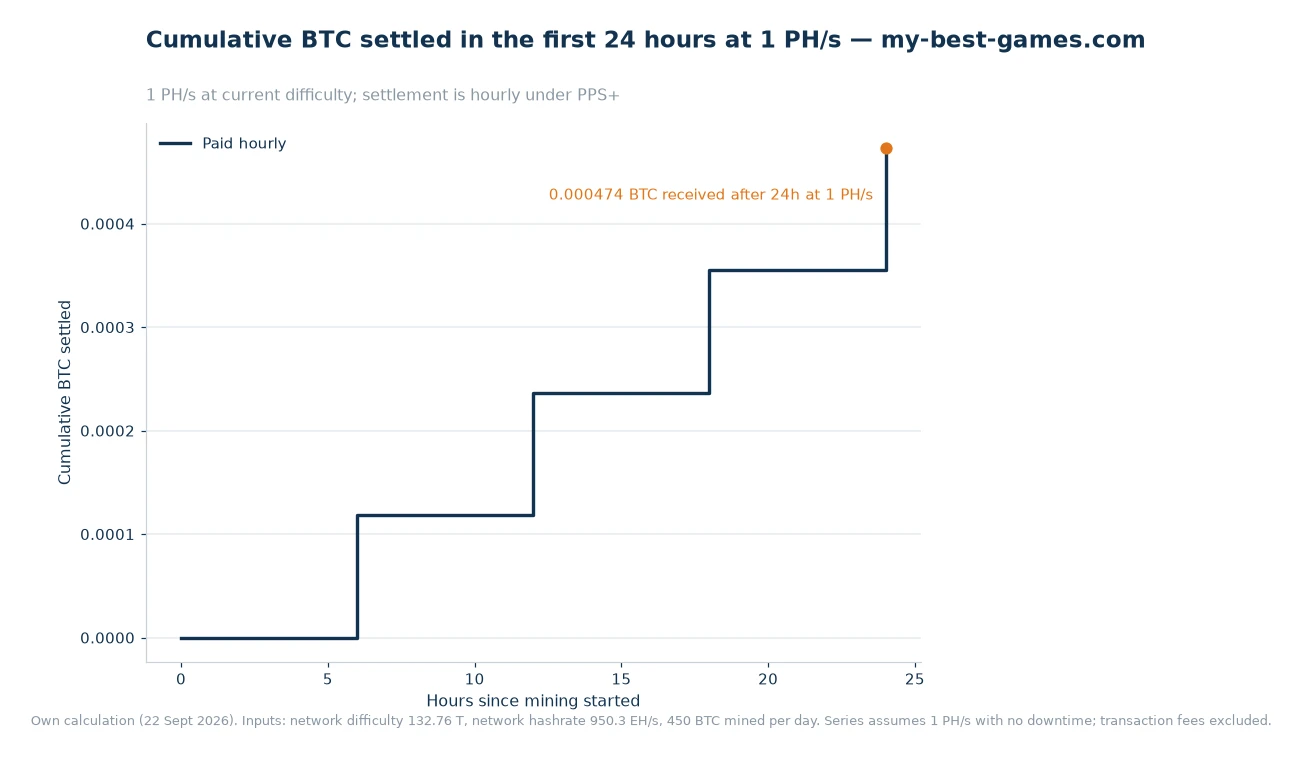
The staircase is what hourly settlement looks like from the outside: 0.00011838 BTC by hour six, 0.00023676 by hour twelve, 0.00047353 by hour 24. A PPLNS balance chart is not a staircase at all — it is a flat line interrupted by steps whose size depends on which blocks the pool found and how many shares were in the window at the time.
Reading the window on the dashboard
Three figures tell you whether the window is being read correctly. The first is your delivered hashrate against the pool's, since shares only count when the machines are actually submitting. The second is the pool's share of the 144 daily blocks, shown as ViaBTC Pool Hashrate beside the network figure. The third is the trend, and the pool statistics page is the place to read it without noise from a single quiet hour.
If the numbers move in a way you did not expect, check the assumptions before blaming the window: the fee schedule shows which component each listed rate attaches to, and the Profit Calculator lets you model both modes against current difficulty instead of comparing two months of balances that had different difficulty.
Frequently asked questions
Does a longer PPLNS window pay me more?
It pays the same expected total over time and less per individual block, because the same block value is spread across more shares. The window changes the spread of outcomes, not the mean.
Why does PPLNS wait for 6 confirmations?
Six confirmations is about an hour at the network's 10-minute block spacing, and it is the point at which the pool treats a block as settled rather than provisional. Credits follow the blocks, so the delay is built into the payout calendar, not into the rate.
Can I switch between PPS+ and PPLNS later?
Yes, and the switch is worth running through a calculator first: at 1 PH/s the difference between the listed 4% and 2% treatment of the block-reward component is about $24.23 a month at constant difficulty and price.
Set the window against your own cash flow
Decide which clock you can live with before deciding which mode looks better on paper. A hosting bill, a loan repayment or a power contract arrives on a schedule, and hourly credits match that schedule better than block arrivals do. If you have runway, the same expected total under PPLNS arrives with a wider spread and a lower fee. Write down the estimated monthly figure for both, at today's difficulty of 132.76 T and today's price, and re-check it after the next adjustment — the window does not change, but what it is worth does.
Data and sources: ViaBTC listed fee schedule[1], plus pool statistics and the public hashrate dashboard[2]. Block spacing, the 144-block daily pace, the 3.125 BTC per-block subsidy, difficulty of 132.76 T, network hashrate of 950.3 EH/s and a BTC price of $85,294 came from public chain data and market feeds, read 22 Sept 2026. All payout figures are arithmetic on those inputs and are not a promise of earnings.