What European Contractors Look For in Formwork Panels
Ask a European formwork buyer what matters and the answer rarely starts with price. It starts with film weight, adhesive class and cycle count: 165 g/㎡ smooth faces or 130 g/㎡ faces, WBP and Phenolic Dynea bonds, and a published reuse range of 10–20 pours for high-grade panels against roughly 3–5 cycles for an economical ordinary black sheet. Everything else in the enquiry follows from those three numbers.
Key takeaways
- Name the film: dark brown, black or anti-slip, at 165 g/㎡ or 130 g/㎡, because the face decides the concrete finish.
- Confirm the bond, not just the description — WBP and Phenolic Dynea classes answer different wet-site questions.
- Compare cycle expectations directly: 10–20 pours for a high-grade sheet against 3–5 for an economical melamine-bonded panel.
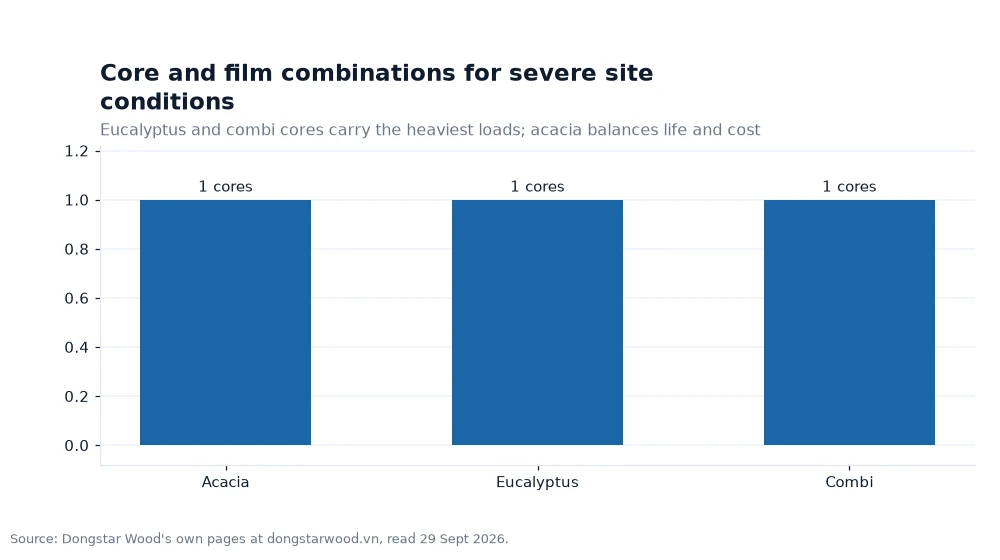
- Check the core by name: acacia for load-bearing life, eucalyptus for stiffness, combi to balance weight and cost.
The enquiry a European contractor actually sends
A well-run buying team sends four lines: thickness, panel size, core and film. Everything else — price, packing, shipment — is negotiated after those four are agreed, because changing any one of them after the order is placed means a new press setting. The published range makes that easy to do: 1500 × 3000 mm is the largest sheet, 1250 × 2500 mm sits in the middle and 1220 × 2440 mm is the base sheet standard formats, custom sheets up to 1830 × 3830 mm, 18 mm as the default for heavy formwork, while bridges and high-load platforms call for 21 mm or more.
The reason thickness comes first is deflection. A contractor whose formwork drawings show bearers at 600 mm centres can work with a lighter sheet than one bracing a transfer slab, and the panel supplier cannot make that call from the other side of the world. Send the drawing note with the enquiry and the quotation will match the site.
The product is ordered as Film Faced Plywood — the family also sold as formwork plywood — and those four lines are what a mill needs before a press setting is fixed. A quotation that arrives without them is an estimate rather than an offer, and it will be revised the moment the drawing note turns up.
Films: dark brown, black and anti-slip
Three film options are named across the range, and each answers a different question. Dark brown film is the conventional choice for walls where finish quality is judged visually. Black film suits contractors who want a consistent face appearance across a set and easier visual inspection of wear. Anti-slip film changes behaviour rather than looks: the textured surface gives grip on walkboards, inclined panels and access routes, which matters on sites where crews walk the formwork before a pour.
Film weight sits behind all three. A 165 g/㎡ phenolic film on a smooth surface keeps a flatter finish for longer and is the heavier specification; a 130 g/㎡ face trims weight and cost per sheet. Ask which one is quoted rather than assuming, because two suppliers can offer the same colour at different film weights and the difference only appears after the fifth or sixth pour.
Adhesive classes a contractor can read
Formwork panels are bonded with E0, E1, E2, MR, WBP or Phenolic Dynea adhesives, and a European buyer usually wants two of those lines explained: what the bond does under repeated wetting, and what the panel emits indoors. WBP and Phenolic Dynea are the classes normally requested for formwork that will be stripped, cleaned and re-used on a wet site; MR covers drier conditions; E0 and E1 speak to emission performance instead of moisture behaviour.
Both belong on the order. A panel can be emission-friendly and unsuitable for a wet basement, or moisture-resistant with a glue line that no one has documented for indoor air quality. Keeping the two conversations apart avoids the usual confusion in tender documents, where emission grades are sometimes mistaken for a durability promise.
| Choice | Named options | What it changes on site |
|---|---|---|
| Film finish | Dark brown, black, anti-slip | Surface appearance and crew grip |
| Film weight | 165 g/㎡ smooth, 130 g/㎡ | How long the finish holds |
| Core | Acacia Core, Eucalyptus Core, Combi Core | Stiffness, handling weight and cost |
| Adhesive | E0, E1, E2, MR, WBP, Phenolic Dynea | Wet-site durability and emissions |
| Thickness | 18 mm heavy formwork; 21 mm and above | Deflection under pour load |
Worked example: panels for one wall run
Counting panels is the quickest way to test whether a quotation fits the job. Take a wall run of 24 m at 3 m high: 24 m × 3 m = 72 m² of formwork contact. Using a 1250 × 2500 mm sheet, 3.125 m² (1.25 × 2.5 m), the run needs 72 ÷ 3.125 = 23.04, so 24 sheets a side, or 48 sheets for a two-sided wall.
Now apply the cycle range. At 10 pours a sheet, 48 sheets cover 48 × 10 = 480 sheet-pours, which is 480 × 3.125 m² = 1,500 m² of contact area; at 20 pours the same set covers 3,000 m². Put against the 72 m² run from the first sum, one set of panels handles roughly 20 repeats of that wall at the lower cycle count and twice that if the faces hold up — the arithmetic that decides whether the second set is bought this year or next.
Reuse expectations and how sites check them
Reuse is where a cheap panel stops being economical. Published guidance puts high-grade panels at 10–20 cycles in concrete pouring work, while an ordinary black film sheet bonded with melamine is typically reused 3–5 times under normal site conditions. On a 20-storey frame those two numbers describe different purchasing plans, not just different unit prices.
Sites check the claim in a simple way: they track which panel went to which pour. Number the sheets, strip them clean while the concrete is still green, keep the stack flat and dry, and reseal edges before they fray. A set that is treated that way is the only fair test of what the supplier promised.
Documentation European sites request
Formwork panels for European projects are usually bought with CE documentation for construction use, and many buyers also ask about emission grades such as E1 or CARB P2 where panels end up in enclosed spaces or furniture-adjacent assemblies. It is worth asking for the documents you actually need rather than accepting a full set of logos, since a scope line and a certificate number are what a site inspector will look for.
Where panels are re-used across a project, keep the delivery documents with the panel set. Traceability becomes valuable the moment a face is questioned, and a batch reference on the packing list is far easier to produce than a reconstruction months later.
Frequently asked questions
Which film weight should a repeat-use formwork set specify?
Heavier faces generally hold finish longer, so a 165 g/㎡ smooth film is the safer choice where a set is expected to run toward 20 cycles. A 130 g/㎡ face reduces weight and cost per sheet and suits shorter campaigns or mixes where panels are recut between pours.
Do European buyers ask for anti-slip panels as well as flat ones?
Increasingly, yes, but for a different reason: anti-slip sheets are specified for access routes, walkboards and inclined panels where crews need grip, not for the concrete finish. Mixing flat and textured panels in one delivery is normal on larger projects.
How much does the core change the quotation?
The core affects weight, stiffness and price together, which is why it is quoted by name. Acacia Core and Eucalyptus Core carry the heaviest demands, while a combi build-up of eucalyptus and acacia balances strength, handling weight and cost for layouts that do not need the densest sheet available.
Comparing two quotations line by line
Set the two offers side by side and walk down one column: thickness, size, core, film weight, adhesive, reuse guidance, packing. Differences usually appear on the third or fourth line rather than the first. Contractors building a mixed order often price the ordinary black film sheet for short campaigns alongside high-grade panels for repeat work, and teams that also buy for interior fit-out look at the commercial panel range in the same enquiry.
Film options, adhesive classes and the reuse ranges discussed here are drawn from the factory's own website, as checked on 29 Sept 2026 as referenced in this article as referenced in this article as the basis for this comparison, with cycle sums given as worked examples[1].