Full-Service Fragrance Partner or Piece-by-Piece Sourcing? An Honest Comparison
There are two ways to build a fragrance project: hand it to one integrated partner, or assemble it yourself from a perfumer, a filler, a packaging trader and a printer. Neither is universally better. The piece-by-piece route can be cheaper and more flexible at scale, and the integrated route removes a category of failure that first-time buyers consistently underestimate — the interfaces between vendors. The right answer depends on how much coordination capacity your team actually has.
Key takeaways
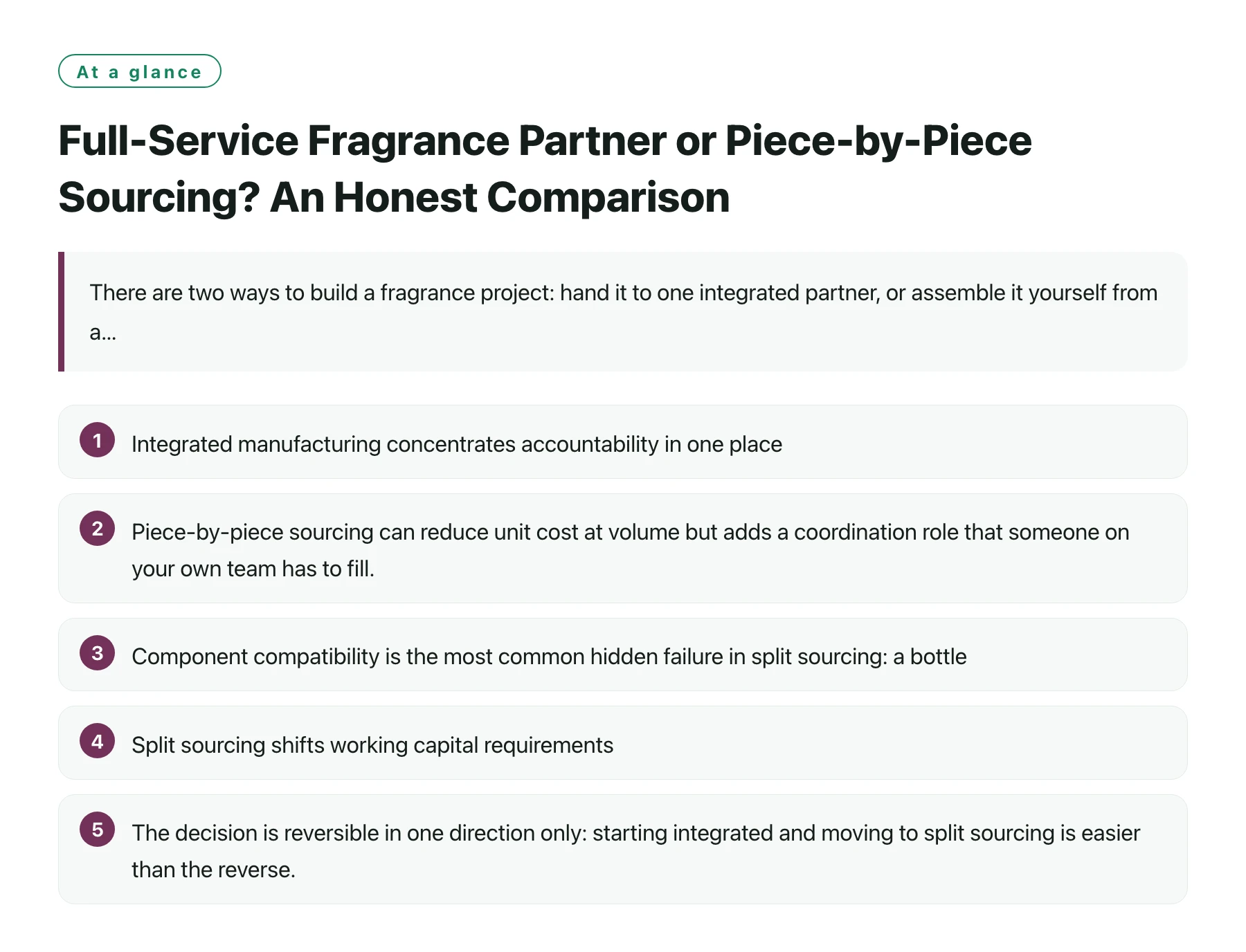
- Integrated manufacturing concentrates accountability in one place, which shortens the argument about who caused a defect.
- Piece-by-piece sourcing can reduce unit cost at volume but adds a coordination role that someone on your own team has to fill.
- Component compatibility is the most common hidden failure in split sourcing: a bottle, a pump and a filling line must agree on dimensions.
- Split sourcing shifts working capital requirements, because several suppliers may each want their own deposit and their own timeline.
- The decision is reversible in one direction only: starting integrated and moving to split sourcing is easier than the reverse.
This comparison is written from the perspective of a brand team of two or three people, which is the realistic shape of most new fragrance businesses. That context matters, because the coordination cost of split sourcing is mostly labour, and small teams feel it directly.
Both models are legitimate. What is not legitimate is choosing a model without knowing which risks you have taken on.
The two models side by side
| Dimension | Integrated OEM/ODM partner | Piece-by-piece sourcing |
|---|---|---|
| Accountability | One party responsible for the finished, packed unit — the shape of full ODM fragrance service | Responsibility is distributed, and interfaces become disputes |
| Unit cost at volume | Often higher, because coordination is priced in | Often lower, if you can commit to component quantities |
| Coordination load | Low, but you depend on the partner's schedule | High, and it lands on your own team |
| Component compatibility | Handled inside the factory between its own stages | Your problem, and it is a technical problem |
| Minimum quantities | Usually one minimum for the finished product | A separate minimum per component, often the real constraint |
| Change of direction mid-project | Negotiated with one counterparty | Re-negotiated with several, with different notice periods |
| Best fit | A team with limited bandwidth launching its first or second line | A team with an experienced product manager and predictable volume |
The row that decides most projects is coordination load. Buyers tend to estimate it at a few emails a week; in practice a split-sourced project with a decorated bottle and a printed carton involves several decisions a day during the packaging window.
Where split sourcing genuinely wins
Split sourcing is not a beginner's mistake. It wins when volume is high enough to justify dedicated tooling, when the brand already has a packaging designer and an operations person, and when the components are standard enough that compatibility is not a research project.
It also wins when the brand wants a component its manufacturer cannot supply — a specific glass house finish, for example, or a closure that only one factory produces. In that situation the practical answer is usually a hybrid: give the manufacturer the filling, the concentrate and the assembly, and nominate a component supplier for the item that matters.
The compatibility trap
A bottle neck finish, a pump stem length and a filling line nozzle have to agree. When three suppliers each supply an item that is individually to specification, the assembly can still fail, and fixing it means replacing one of the three. In an integrated scope, the same mismatch is caught internally at the sample stage, before the order is placed.
The compliance trap
Cosmetic products are regulated as finished products, not as components. In several markets the responsible party has to hold a product information file covering the formula, the packaging and the labelling, and the requirements are published by the regulators that enforce them [1]. Splitting the supply chain does not split that obligation: one party still has to assemble the file, and it is usually the brand.
Where integrated manufacturing earns its premium
An integrated partner is paid for coordination, and the observable value is schedule reliability. When blending, filling, decoration and packing sit in one operation, a delay at one stage is visible to the people managing the next, and the fix does not require a three-way call.
The second value is that the same party has already solved compatibility for the components it holds. A manufacturer that also designs bottle and pack formats has an existing library of pairings that are known to work, which shortens the sampling stage considerably. Comparing offers is still worth the effort, because the same project can be priced in very different ways depending on which costs sit inside the scope and which are billed afterwards cost drivers in custom fragrance wholesale.
What to verify before accepting the integrated route
Integrated does not mean self-sufficient. Ask what is genuinely done in house and what is bought in, because a partner that subcontracts most stages offers the accountability of integration with the coordination risk of split sourcing. A manufacturer that describes its scope as their OEM/ODM manufacturing services should be able to answer that in a single written list.
Keep the component specification yours
Whichever model you choose, hold the specification. Component drawings, colour references and artwork files should exist in your own files, not only in the supplier's. If the relationship ended, that folder is what allows another factory to reproduce the product rather than reinterpret it.
A workable decision rule for a small team: if the project involves a custom bottle, a decorated closure or a printed carton with a new die, start integrated. Those are exactly the items where split sourcing creates the most interface risk and the least saving.
Sources
- European Commission: Cosmetics in the EU —— The European Commission's overview of EU cosmetics rules, including the responsible person, product information file and safety report requirements.
Frequently asked questions
Is an integrated manufacturer always more expensive?
Not always, but often at volume, because coordination and internal handling are priced into the service. At low volume the difference frequently reverses, since a split project cannot reach the minimum quantities that would make separate component sourcing worthwhile.
Can I use my own bottle supplier with a manufacturer's filling line?
Usually yes, if the components are specified in advance and samples are assembled and tested before the bulk production run. The critical step is a trial assembly, not a data sheet comparison.
Who is responsible for compliance if several suppliers are involved?
The obligation attaches to the finished product and generally sits with the brand or the responsible person in the destination market. Splitting the supply chain does not reduce it, so someone has to own assembling the product information file.
What is the biggest risk in split sourcing?
Interface failure: components that each meet their own specification but do not work together, or a schedule that slips at one vendor without the others being told. Both are manageable with a named coordinator and a written schedule.
Can I change models later?
Moving from split sourcing to an integrated partner is usually straightforward, because the brand already holds specifications. Moving the other way is harder, since the integrated partner often holds the tooling and the pack design.