Plywood Cabinets: Weight, Freight and Installation
Cabinet weight is mostly panel, and panel is mostly the box. A CasaBuilt base cabinet is 34-1/2 inches high and 24 inches deep in a 1/2-inch birch plywood carcass, with a 3/4-inch face frame and 3/4-inch shelves, and that combination is what arrives on the pallet. Knowing where the mass sits changes how you unload it, store it and hang it.
Key takeaways
- The published box is 1/2-inch plywood, with a 3/4-inch face frame and 3/4-inch shelves doing the stiffening.
- RTA cabinets ship in 3-10 business days; pre-assembled cabinets are quoted at within two weeks.
- Free shipping applies at $2,500, and Alaska and Hawaii are outside the standard RTA window.
- A $500 gap can swallow a $459.26 base cabinet and still leave $40.74 to find.
Where the weight actually sits
A cabinet is not heavy because of its hardware. Hinges, glides and handles weigh little. The mass is in the panels: two sides, a bottom, a top, a back, a face frame and at least one shelf, plus the doors and drawer boxes on the front. Change the panel gauge and you change the weight of the whole order.
CasaBuilt's published construction puts the thin panel where it is least handled and the thick ones where the load is. The 1/2-inch box keeps the carcass manageable, the 3/4-inch face frame stiffens the open front, and the 3/4-inch shelves carry what goes inside. Drawers are 5/8-inch rubberwood with dovetail corners, which is heavier than a stapled box of the same size and far less likely to rack out of square.
That distribution matters on delivery day because it decides how the order is packed. A flat carton holds panels, not a box, so the weight is spread across a thin package that two people can carry. An assembled cabinet concentrates the same panels into a rigid volume that is easier to set but harder to lift over a worktop. The panel breakdown is published for every style in the plywood rta cabinets collection, which is where to check the 1/2-inch box and the 3/4-inch shelf before placing a heavy order.
Flat pack, assembled and the difference at the kerb
RTA cabinets arrive flat-packed with all hardware and step-by-step guides, plus assembly videos and support. The trade-off is work: someone has to build each box before it can be hung. Pre-assembled cabinets arrive built, within two weeks according to the home page, and the trade quick-ship program covers eligible orders in three business days or less.
At the kerb the two routes feel different. Flat pack means many cartons, each light enough to move alone, and a garage or spare room full of labelled panels that need to stay dry and flat until assembly. Assembled means fewer, bulkier pieces that two people carry with a hand truck, and a much shorter path from truck to wall.
CasaBuilt also sells sample doors at $9.99 from a stock of 16, refundable with a cabinet purchase. A sample is the lightest way to judge a finish and to feel the panel before committing to a full order, and it costs far less than a wrong guess on a whole kitchen.
The $2,500 freight line
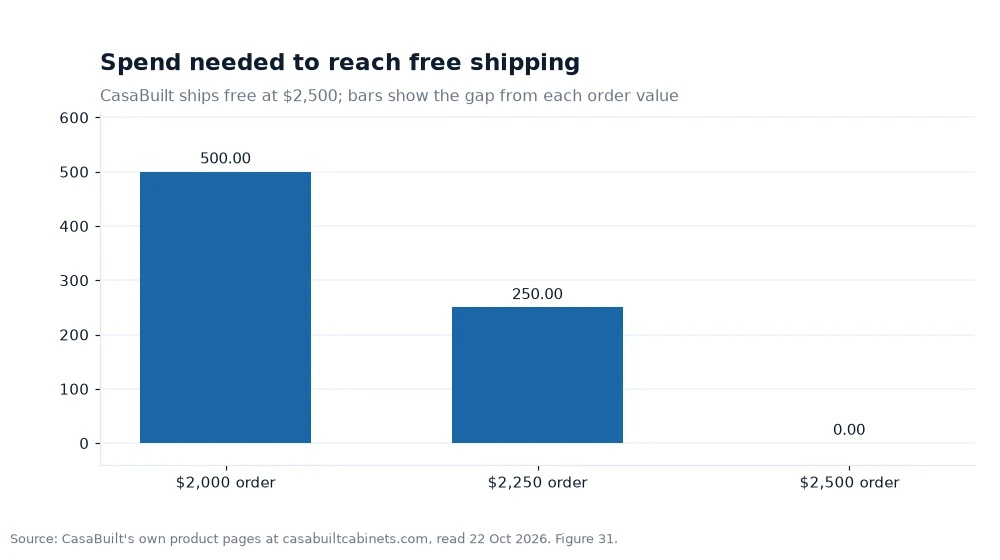
Free shipping starts at $2,500. Below that figure the freight is a real line on the invoice, and the gap to the threshold is sometimes smaller than the item a buyer is about to add anyway. The table uses published sale prices to show combinations that actually close the gap rather than landing near it.
| Order value | Still needed | Published pieces that close it | New order |
|---|---|---|---|
| $2,000 | $500 | 30 in high double-door wall at $347.76 + 12 in glass stacker, double door, at $160.74 | $2,508.50 |
| $2,250 | $250 | 30 in high single-door wall at $179.54 + 12 in glass stacker, single door, at $95.82 | $2,525.36 |
| $2,500 | $0 | No addition needed | $2,500.00 |
The useful lesson is that a single cabinet rarely closes a large gap. A 24 to 27 inch base at $459.26 is the obvious purchase for a $2,000 order, and it leaves $40.74 short of free shipping, so the freight charge can still apply. Two smaller pieces usually finish the job better than one big one.
Two people, one wall cabinet, one level line
Wall cabinets are the part of the job that hurts if it is rushed. A 30-inch wall cabinet is a rigid box with a door on the front, and it has to be held at a line while someone drives screws into studs. CasaBuilt's cabinets are 12 inches deep, which keeps the weight close to the wall, but the lift still wants two people and a temporary ledger board screwed to the wall at the bottom height.
Find the studs before anything is unpacked. Cabinet screws go into framing or into a proper blocking rail, never into drywall alone. Mark the level line around the room, because floors and ceilings are rarely level and a run that follows the floor will show a tapering gap under the upper cabinets. Shims go behind the cabinet at the studs, and the face frame is what gets checked with the level, not the door.
For RTA orders, assembly belongs to the buyer, and the sensible sequence is to build every box first, check the square of each one, then hang. A carcass that is a few millimeters out of square will show in the door gaps, and it is easier to fix on the floor than on the wall.
Worked example
The chart gives the gap to free shipping at three order values. At $2,000 the gap is 2,500 - 2,000 = $500. At $2,250 it is 2,500 - 2,250 = $250. At $2,500 it is 2,500 - 2,500 = $0.
Express each gap as a share of the order. At $2,000, 500 / 2,000 = 25 percent. At $2,250, 250 / 2,250 = 11.1 percent. At $2,500 the share is zero. A quarter of the order value is a large add-on, which is why the $2,000 buyer should decide whether the extra cabinet is genuinely wanted before spending to reach the threshold.
Then test the add-on against the gap. The 24 to 27 inch base at $459.26 covers 459.26 / 500 = 91.9 percent of the $500 gap and leaves $40.74. The 30-inch single-door wall at $179.54 covers 179.54 / 250 = 71.8 percent of the $250 gap, leaving $70.46. At $2,250, two single-door walls give 2 x $179.54 = $359.08, which passes the threshold by $359.08 - $250 = $109.08. The arithmetic is simple; the point is to run it before checkout rather than after the freight appears.
Frequently asked questions
How much does a flat-packed cabinet weigh?
CasaBuilt does not publish unit weights, so there is no figure to quote. What the specification does show is where the mass is: a 1/2-inch plywood box, a 3/4-inch face frame, 3/4-inch shelves and 5/8-inch dovetail drawers. Flat pack spreads those panels across several thin cartons, which is why each one is easier to carry than a built cabinet.
Does free shipping apply to Alaska and Hawaii?
No. Alaska and Hawaii are excluded from the standard RTA shipping window, so those orders need a conversation with support before checkout. The published 3-10 business day RTA window applies to the standard service area.
Can one person install wall cabinets?
It is possible for a small cabinet with a ledger board and a support prop, and it is a bad idea for a 30-inch box. A wall cabinet has to be held at the line while screws are driven, and the person holding it cannot also check the level. Plan for two people, or hire the hanging step.
Weigh the order, not just the price
Count the boxes, note which ones are assembled and decide where the cartons will live until installation day. Group the order so that a $2,500 basket is deliberate rather than two dollars over or forty dollars under. Then book a second pair of hands for the wall run, because that is the part of the job where the panels stop being boxes and start being a kitchen.
Figures quoted here come from the manufacturer's own website, read 22 Oct 2026[1].