Turnkey Versus Piece-by-Piece Brewery Purchases
A piece-by-piece brewery usually looks cheaper on the quotation and more expensive on the calendar. Turnkey supply means one company specifies the whole plant, integrates the components and carries the commissioning, training and spare-parts conversation afterwards; HGMC builds complete breweries as its speciality and publishes installation, commissioning, operator training, maintenance and spare parts as part of the service list. The hgmc brew system approach is worth comparing line by line against a shopping list of separate purchases, because the differences show up in places buyers rarely price.

Key takeaways
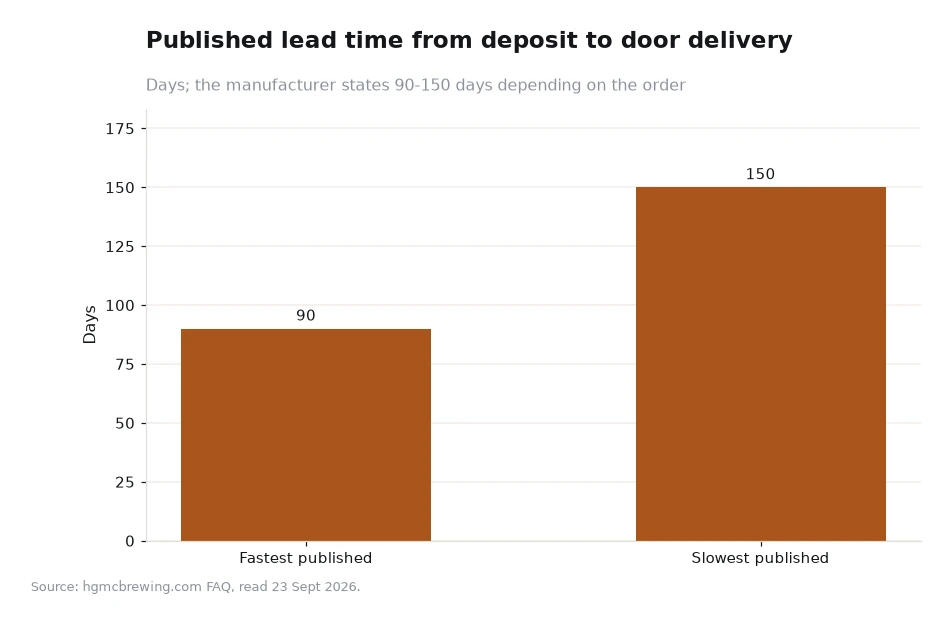
- A turnkey order arrives with one delivery window, published as 90-150 days from deposit to door depending on the order, rather than one window per supplier.
- Warranty cover of 6 years on tank accessories and electronic components against manufacturing defects from the factory, used within scope, is easier to claim against one supplier than six.
- Design work is published as a free 2D, 2.5D and 3D service covering layout and vessel and piping design, which is where integration mistakes are made and caught.
- Spare parts supply is part of the published service list, so a replacement pump or seal comes from the same place as the plant that holds it.
Where the two routes really differ
The equipment itself can end up almost identical: the same stainless steel 304 or 316 vessels, the same TIG 100% full welding, the same plate thicknesses of 3 mm and 2 mm. What differs is who owns the interfaces. On a turnkey project the supplier answers for pipe sizes, valve schedules, control logic and the water and steam balance, and the buyer answers for the building. On a piece-by-piece project every interface is a meeting: which pump has the right curve for the heat exchanger, which valve thread matches the tank outlet, which controller talks to which sensor. Those meetings are free in the sense that nobody invoices for them, and expensive in the sense that they consume the weeks that were supposed to be selling beer.
Integration risk is the hidden line item
Integration risk is not a penalty clause; it is the ordinary friction of parts made by different companies arriving on the same floor. Pumps sized to one supplier's heat exchanger, a control cabinet wired to another's sensors, a keg washer expecting a different pressure: each mismatch looks small and each one stops a brew day. A single supplier that specifies the lot has an incentive to check those matches before shipping, and it carries the responsibility if one is wrong. This is the practical meaning of a turnkey project: not that no problem can occur, but that when one does, there is one place to take it.
Spares, warranty and the first year of running
The first year of production is when a component fails, and how that failure is handled depends entirely on who supplied the plant. One supplier means one spares list, one contact and one warranty position, which for a brewery is the difference between a day of chasing and a fortnight of waiting. The published cover is 6 years on tank accessories and electronic components against manufacturing defects from the factory, used within scope, and sales and engineers keep 24 hours online. Add in the published service list — installation, commissioning, operator training, maintenance support and spare parts supply — and the case for buying the plant rather than assembling it gets clearer every month it runs.
There is a second, quieter benefit. A single specification means the plant is documented as one system: one set of drawings, one pipe schedule, one list of wear parts with sizes on it. When a brewery changes hands, or when the person who built it moves on, that documentation is the difference between maintenance and guesswork, and it is usually the first thing an equipment surveyor asks to see.
| Item | Turnkey route | Piece-by-piece route |
|---|---|---|
| Design and drawings | 2D, 2.5D and 3D layout and piping design included free of charge | Layouts drawn by the buyer or a third party, then checked against each supplier's own drawing |
| Interface risk | Pipe sizes, valve schedule and control logic are one supplier's responsibility | Each mismatch is a separate negotiation between two parties who do not work together |
| Delivery | One published window of 90-150 days from deposit to door | Several windows to sequence, with the slowest supplier setting the date |
| Warranty | 6 years on tank accessories and electronic components, used within scope, from one source | One claim per supplier, each with its own terms and lead times |
| Commissioning and training | Published as part of the service list, by the team that built the plant | Bought separately, often from whoever is available at the time |
Worked example: what coordination hours and downtime cost
The arithmetic below is an example and its assumptions are stated. Assume a brewery with twelve main line items — brewhouse, tanks, glycol, chiller, pumps, valves, heat exchanger, CIP, control cabinet, platform, pipework and packaging. Buying piece by piece from six suppliers, at an average of four hours per supplier for specification, drawings, delivery chasing and site questions, comes to 6 x 4 = 24 hours of the buyer's time, plus two extra site visits at 8 hours each, so 24 + 16 = 40 hours. Buying turnkey from one supplier, assume 8 hours of the same work, so the difference is 40 - 8 = 32 hours of project management. Now price the risk in beer rather than in hours: if a mismatch between two suppliers stops brewing for two days on a 2,000 litre line running one brew a day, that is 2,000 x 2 = 4,000 litres, or about 34 barrels, of production lost. Whether the 32 hours and the lost barrels matter depends on how many other projects are competing for the same attention — which is exactly the question a turnkey quotation is really answering.
Frequently asked questions
Is a turnkey brewery more expensive than buying the equipment separately?
Not necessarily: the vessels are the same stainless steel 304 or 316 builds either way, and the published design service is free, so the comparison usually turns on coordination hours and interface risk rather than steel price.
What warranty comes with a complete brewery from one supplier?
Cover of 6 years on tank accessories and electronic components against manufacturing defects from the factory, used within scope, with 24/7 sales availability and spare parts supply published as part of the service.
Decide the route before you write the specification
The purchase route shapes the specification, so choose it first: either one supplier answers for the whole plant, or you keep the interfaces yourself and accept the coordination they carry. A middle path also works well — turnkey for the hot side, fermentation and cooling, and separate orders for packaging and furniture — as long as the pipe sizes and utility connections are fixed in one drawing set. HGMC supplies equipment from 1 BBL to 100 BBL, exports to more than 120 countries, works in compliance with the ISO9001:2015 quality management system and publishes 2D, 2.5D and 3D design as part of the service. Read the brewery system pages and the brewhouse equipment details with the same specification in hand, and send that specification back with the questions that matter to your site.
Service scope, warranty wording, quality-system compliance and delivery windows above come from the manufacturer's own website at hgmcbrewing.com, read on 23 Sept 2026; the coordination hours, site visits and lost-production figures are our own labelled examples. Confirm the published terms before you order[1].