230 TH/s in Real Terms: What the Pool Credits and What Power Takes
At 230 TH/s the pool credits about 0.00010318 BTC a day, which is $8.74 at $84,692 per BTC and $8.39 after the listed 4% on the block-reward component. The figure that decides whether the machine is worth switching on is smaller and less quoted: what it pays for electricity. At 25 J/TH and $0.06 per kWh, the same rig spends roughly $8.28 a day on power, which leaves about eleven cents.

Key takeaways
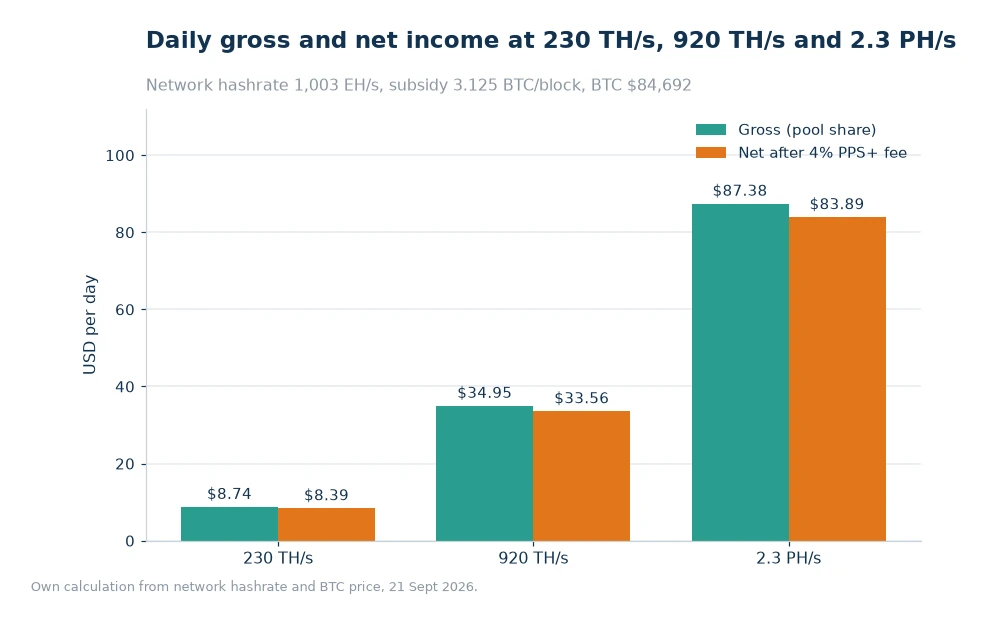
- 230 TH/s produces 0.00010318 BTC a day, $8.74 gross and $8.39 after the listed 4% on the block-reward component.
- 920 TH/s is exactly four times the first figure at $34.95 gross and $33.56 net, with no change in the per-terahash rate.
- 2.3 PH/s, ten times the base case, reaches $87.38 gross and $83.89 net a day.
- At 25 J/TH and $0.06 per kWh the 230 TH/s rig spends about $8.28 on power, so the tariff decides the margin.
The pool half of the ledger
Daily issuance is fixed by the protocol: 3.125 BTC per block and 144 blocks a day come to 450 BTC. Your claim on that issuance is your share of the network, and the network is running at roughly 1,003 EH/s with difficulty at 132.76 T. Divide 450 BTC by 1,003,107,267,295 GH/s and you get 0.00000044861 BTC per terahash per day, a constant that does not care how the machine is cooled or where it stands.
Multiply by 230 and the daily gross is 0.00010318 BTC. Everything downstream of that is a price conversion or a fee, which is why the coin figure is the stable part of the story and the dollar figure is the noisy one. A 10% move in the BTC price moves the dollar line by 10%. A 10% rise in network hashrate at the next difficulty adjustment moves the coin line down by roughly 9%, and the estimate for the next adjustment was minus 2.12% when the chain data was read, which points the other way for now.
Two lines on the fee schedule, not one
The default payout is PPS+. It settles hourly against current difficulty, and it carries a listed 4% on the PPS-settled block reward plus a listed 2% on the transaction-fee component. Those are two charges on two different income streams, not a single rate applied to the total. On an arithmetic model built from subsidy alone, the 4% line is the only one that bites: 0.00010318 BTC becomes 0.00009905 BTC, or $8.39.
PPLNS works the other way around. The block reward and the transaction fees are pooled and settled together under a listed 2% rate, and payment lands after 6 confirmations, with each miner's slice measured over the last 5 difficulty rounds. On subsidy alone, that 2% line leaves 0.00010112 BTC a day, about 17 cents more than the PPS+ figure at this price. The extra is not free: under PPLNS the miner carries pool luck and the variance that comes with it, which is exactly what the higher listed rate under PPS+ buys out. The fee schedule prints both rates side by side, which is worth reading before either method is chosen for a small rig.
Putting the account and the meter side by side
Efficiency in joules per terahash is the bridge between the two ledgers. Multiply joules per terahash by terahashes and you have watts. 25 J/TH at 230 TH/s is 5,750 W, or 5.75 kW, and 5.75 kW running for 24 hours is 138 kWh. At $0.06 per kWh that is $8.28, which sits against a net credit of $8.39 and leaves eleven cents before anything else is paid for.
The credit side of that comparison is visible in the ViaBTC Crypto Mining account, hour by hour, because PPS+ settles hourly rather than at the end of a month. The cost side is not on any dashboard: it comes from your own meter, your own tariff and the fixed items that do not scale, such as a network link, a fan, a rented corner of a room or the interest on the hardware. Those items are small in absolute terms and large relative to eleven cents.
Three sizes, one constant
The table holds efficiency and tariff still, at 25 J/TH and $0.06 per kWh, so that the only thing moving is hashrate. Net income here means the PPS+ credit after the listed 4% and says nothing about power; the last column is the power bill that has to come out of it.
| Hashrate | BTC per day | Gross USD | Net USD | Power cost |
|---|---|---|---|---|
| 230 TH/s | 0.00010318 | $8.74 | $8.39 | $8.28 |
| 920 TH/s | 0.00041273 | $34.95 | $33.56 | $33.12 |
| 2.3 PH/s | 0.00103179 | $87.38 | $83.89 | $82.80 |
The pattern is the point. Every column scales in a straight line, so the margin stays at eleven cents per 230 TH/s and the question of viability does not improve with size. What changes with size is the weight of fixed costs: one network link and one monitoring habit cover ten machines almost as easily as one, and that is where a larger operation finds its advantage.
Worked example
Follow the 230 TH/s case from the network total to the margin, using the same inputs as the chart.
- Per terahash: 450 BTC a day divided by 1,003,107,267,295 GH/s gives 0.00000044861 BTC.
- 230 TH/s: 230 multiplied by 0.00000044861 is 0.00010318 BTC a day.
- Fee: the listed 4% applies to the block-reward component, so 0.00010318 multiplied by 0.96 is 0.00009905 BTC.
- Dollars: 0.00010318 multiplied by 84,692 is $8.74 gross, and 0.00009905 multiplied by 84,692 is $8.39 net.
- Power: 230 multiplied by 25 J/TH is 5,750 W, and 5.75 kW multiplied by 24 hours is 138 kWh.
- Cost: 138 kWh multiplied by $0.06 is $8.28, so the margin is $8.39 minus $8.28, or $0.11.
- Scale check: 920 TH/s is four times 230, so 4 multiplied by $8.39 is $33.56 net, and 4 multiplied by $8.28 is $33.12 of power.
- Top row: 2.3 PH/s is ten times 230 TH/s, so 10 multiplied by 0.00010318 is 0.00103179 BTC, or $87.38.
Where a thin margin turns negative
Change one input at a time and the eleven cents disappears quickly. At 30 J/TH the same 230 TH/s draws 6.9 kW, which is 165.6 kWh a day and $9.94 at $0.06, so the machine runs at a loss before any other cost. At 25 J/TH but a tariff of $0.08, the bill is $11.04 and the loss is $2.65. Move the other way, to 20 J/TH and $0.04, and the bill falls to $4.42, leaving $3.97 a day.
None of those adjustments touches the pool. The credit is what it is at a given hashrate, price and difficulty, and the listed rate is published rather than negotiated. That leaves efficiency, tariff and the price of the hardware as the variables a miner actually controls, and of the three the tariff is usually the easiest to measure and the hardest to change once a site is chosen. A rig that only works at one power price is a bet on that price, not a mining plan.
Frequently asked questions
How much does 230 TH/s earn in a day?
At 1,003 EH/s, 3.125 BTC per block and $84,692 per BTC, 230 TH/s earns 0.00010318 BTC a day, which is $8.74 gross and $8.39 after the listed 4% on the block-reward component, before any power cost.
Is the listed 4% taken from everything I earn?
No. Under PPS+ the listed 4% applies to the PPS-settled block reward and a listed 2% applies to the transaction-fee component, while PPLNS applies a listed 2% to the two components pooled together.
What power price does 230 TH/s need to stay ahead?
At 25 J/TH the rig uses 138 kWh a day, so every $0.01 per kWh costs $1.38; the net credit of $8.39 covers a tariff of about $0.06 and is gone by roughly $0.0607 per kWh.
Measure both sides before the next order
Write the daily net credit at the top of a page and the daily kWh multiplied by the tariff underneath it. If the gap is a few percent of the credit, a difficulty step or a tariff step will erase it, and no pool setting changes that. The Profit Calculator will produce the credit line from hashrate, difficulty and the listed rate; the second line needs a meter reading. Comparing the two before buying is cheaper than discovering the answer with a machine already racked.
Sources: the ViaBTC homepage for PPS+ and PPLNS settlement terms and the listed 4% and 2% rates[1]. Chain inputs read 21 Sept 2026: network hashrate 1,003 EH/s, difficulty 132.76 T, subsidy 3.125 BTC per block, 144 blocks a day, BTC $84,692. Published 22 Oct 2026. Dollar figures are arithmetic on those inputs and on the stated efficiency and tariff assumptions.