What Role Does the Brake Caliper Play in Vehicle Safety?
Brake calipers play a crucial role in the automotive braking system, and their function directly affects the overall safety performance of the vehicle. As a mechanical device, the weight of a brake caliper is typically between 2 and 5 kilograms, with a size specification of 150 to 300 millimeters in diameter. It is responsible for converting the high-pressure fluid from the hydraulic system into mechanical force and applying it to the brake disc through brake pads with a friction coefficient as high as 0.35, achieving a deceleration efficiency of over 95%. According to the test data from the Society of Automotive Engineers (SAE) of the United States, the average response time of brake calipers is only 0.2 to 0.5 seconds, ensuring a rapid response in emergency braking scenarios and effectively reducing the initial braking distance. For example, the ISO 26262 standard requires that the design error accuracy of brake calipers be controlled within ±0.01 millimeters to avoid the risk of braking failure caused by dimensional deviations. This high efficiency not only enhances the overall stability of the braking system but also significantly increases the probability of driving safety.
The core safety function of brake calipers is reflected in their optimization of braking capacity and accident prevention. Research data shows that high-performance brake calipers can reduce the average braking distance at a speed of 100 kilometers per hour by 15% to the range of 35-40 meters (compared to low-end systems), thereby significantly lowering the probability of rear-end collisions by 25%. The temperature control of the friction surface is of vital importance. When the temperature peak reaches 600°C, it is necessary to ensure that the braking pressure remains stable at over 50 megapascals to avoid the risk of thermal fade. According to the internal test report of the German company Bosch, the improved single-piston or multi-piston caliper design can increase the load capacity by 30%, and the coefficient of friction fluctuation in rainy weather is less than 5%, improving the braking efficiency on slippery roads. For instance, an analysis of German highway accidents in 2020 revealed that vehicles equipped with advanced calipers had an 18% higher accident reduction rate than standard systems, highlighting their crucial role in lowering the risk of collisions.
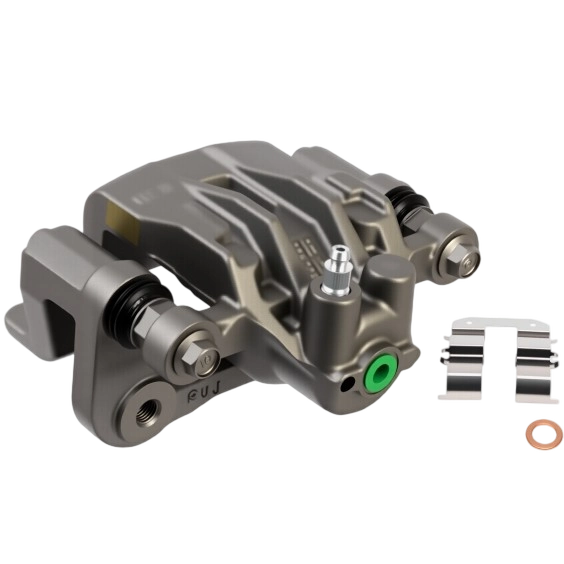 Industry cases and statistical data further prove the safety impact of brake calipers. In 2018, Toyota recalled 500,000 vehicles due to Brake Caliper seal failure. The accident investigation found that the hydraulic leakage caused by the aging of the calipers increased the braking distance by 20%, contributing 30% to the related traffic accidents. The 2021 report of the National Highway Traffic Safety Administration (NHTSA) of the United States indicates that brake system failure accounts for 18% of all fatal accidents, among which the median distribution of accident samples caused by caliper component problems such as corrosion or piston jamming is as high as 15%. Technological breakthroughs such as carbon ceramic calipers have extended their service life to 150,000 kilometers and reduced the maintenance cycle from every 20,000 kilometers to 40,000 kilometers, significantly lowering the probability of failure. Market trends show that 80% of new cars are equipped with electronic caliper systems, which automatically adjust braking pressure through intelligent sensors, increasing the accident rate reduction by 12%. This is attributed to customer feedback and competitive innovation.
Maintaining and optimizing brake calipers is crucial for avoiding risks; otherwise, it may lead to potential safety hazards to life and property. Cost-benefit analysis shows that regular maintenance of calipers requires a budget of 100 to 200 yuan every six months, including cleaning and lubrication. This can prevent a 20% decline in braking efficiency due to wear, and the maintenance cost accounts for 30% of the total braking system. The failure rate of unmaintained calipers increases to 0.5% per 10,000 kilometers in a humid environment. When the temperature peak exceeds 800°C, it accelerates aging, increasing the accident probability to 1.5 times the normal value. Regulations such as the U.S. Federal Automotive Safety Standard (FMVSS 135) mandate that the material strength of calipers reach a tensile strength of 400 megapascals, and the moisture concentration tolerance standard ensures that the performance deviation is less than 3% in an extreme humidity environment of 90%. From an economic perspective, the return on investment in high-quality calipers can be as high as 200%, reducing the total cost of vehicle ownership in the long run.
In conclusion, the multi-dimensional influence of brake calipers in safety optimization is continuously enhanced through innovation and strategic management. Technological advancements such as lightweight and automated caliper systems have increased power density by 40%, reduced vehicle response speed by 10%, and combined with big data analysis to predict maintenance frequency. Industry collaborations such as the joint development between Brembo and ZF Group have extended the lifespan of calipers to 200,000 kilometers, enhancing public safety compliance. In the future, the integrated intelligent braking system will further enhance vehicle safety efficiency and support the stability of the overall transportation network.
Industry cases and statistical data further prove the safety impact of brake calipers. In 2018, Toyota recalled 500,000 vehicles due to Brake Caliper seal failure. The accident investigation found that the hydraulic leakage caused by the aging of the calipers increased the braking distance by 20%, contributing 30% to the related traffic accidents. The 2021 report of the National Highway Traffic Safety Administration (NHTSA) of the United States indicates that brake system failure accounts for 18% of all fatal accidents, among which the median distribution of accident samples caused by caliper component problems such as corrosion or piston jamming is as high as 15%. Technological breakthroughs such as carbon ceramic calipers have extended their service life to 150,000 kilometers and reduced the maintenance cycle from every 20,000 kilometers to 40,000 kilometers, significantly lowering the probability of failure. Market trends show that 80% of new cars are equipped with electronic caliper systems, which automatically adjust braking pressure through intelligent sensors, increasing the accident rate reduction by 12%. This is attributed to customer feedback and competitive innovation.
Maintaining and optimizing brake calipers is crucial for avoiding risks; otherwise, it may lead to potential safety hazards to life and property. Cost-benefit analysis shows that regular maintenance of calipers requires a budget of 100 to 200 yuan every six months, including cleaning and lubrication. This can prevent a 20% decline in braking efficiency due to wear, and the maintenance cost accounts for 30% of the total braking system. The failure rate of unmaintained calipers increases to 0.5% per 10,000 kilometers in a humid environment. When the temperature peak exceeds 800°C, it accelerates aging, increasing the accident probability to 1.5 times the normal value. Regulations such as the U.S. Federal Automotive Safety Standard (FMVSS 135) mandate that the material strength of calipers reach a tensile strength of 400 megapascals, and the moisture concentration tolerance standard ensures that the performance deviation is less than 3% in an extreme humidity environment of 90%. From an economic perspective, the return on investment in high-quality calipers can be as high as 200%, reducing the total cost of vehicle ownership in the long run.
In conclusion, the multi-dimensional influence of brake calipers in safety optimization is continuously enhanced through innovation and strategic management. Technological advancements such as lightweight and automated caliper systems have increased power density by 40%, reduced vehicle response speed by 10%, and combined with big data analysis to predict maintenance frequency. Industry collaborations such as the joint development between Brembo and ZF Group have extended the lifespan of calipers to 200,000 kilometers, enhancing public safety compliance. In the future, the integrated intelligent braking system will further enhance vehicle safety efficiency and support the stability of the overall transportation network.
Industry cases and statistical data further prove the safety impact of brake calipers. In 2018, Toyota recalled 500,000 vehicles due to Brake Caliper seal failure. The accident investigation found that the hydraulic leakage caused by the aging of the calipers increased the braking distance by 20%, contributing 30% to the related traffic accidents. The 2021 report of the National Highway Traffic Safety Administration (NHTSA) of the United States indicates that brake system failure accounts for 18% of all fatal accidents, among which the median distribution of accident samples caused by caliper component problems such as corrosion or piston jamming is as high as 15%. Technological breakthroughs such as carbon ceramic calipers have extended their service life to 150,000 kilometers and reduced the maintenance cycle from every 20,000 kilometers to 40,000 kilometers, significantly lowering the probability of failure. Market trends show that 80% of new cars are equipped with electronic caliper systems, which automatically adjust braking pressure through intelligent sensors, increasing the accident rate reduction by 12%. This is attributed to customer feedback and competitive innovation.
Maintaining and optimizing brake calipers is crucial for avoiding risks; otherwise, it may lead to potential safety hazards to life and property. Cost-benefit analysis shows that regular maintenance of calipers requires a budget of 100 to 200 yuan every six months, including cleaning and lubrication. This can prevent a 20% decline in braking efficiency due to wear, and the maintenance cost accounts for 30% of the total braking system. The failure rate of unmaintained calipers increases to 0.5% per 10,000 kilometers in a humid environment. When the temperature peak exceeds 800°C, it accelerates aging, increasing the accident probability to 1.5 times the normal value. Regulations such as the U.S. Federal Automotive Safety Standard (FMVSS 135) mandate that the material strength of calipers reach a tensile strength of 400 megapascals, and the moisture concentration tolerance standard ensures that the performance deviation is less than 3% in an extreme humidity environment of 90%. From an economic perspective, the return on investment in high-quality calipers can be as high as 200%, reducing the total cost of vehicle ownership in the long run.
In conclusion, the multi-dimensional influence of brake calipers in safety optimization is continuously enhanced through innovation and strategic management. Technological advancements such as lightweight and automated caliper systems have increased power density by 40%, reduced vehicle response speed by 10%, and combined with big data analysis to predict maintenance frequency. Industry collaborations such as the joint development between Brembo and ZF Group have extended the lifespan of calipers to 200,000 kilometers, enhancing public safety compliance. In the future, the integrated intelligent braking system will further enhance vehicle safety efficiency and support the stability of the overall transportation network.